


In the movie Moneyball, everyone is looking at baseball players the same old way
batting average, looks, popularity. But one person changes the game. He doesn’t play harder. He doesn’t shout louder. He thinks differently. And suddenly, average players start winning games. That exact same thing happens in offices every single day. Some employees follow the rules. Some work long hours. But a few people change how value is created and those people get promoted and paid more.
Today, I’m going to show you exactly what to do at work to: Get promoted faster, Earn more money, Get recognized by leadership, And move from “just another employee” to someone leadership depends on. And yes this works even if you’re quiet, introverted, or hate office politics.
1. The Method of Getting Promoted Fast:
Let’s break this into clear steps.
Step1.Master Your Current Role (Baseline): This is non-negotiable.
If you’re bad at your job: No strategy saves you. Competence is the entry ticket, not the prize.
Step2.Identify Repeating Problems: Promotion lives inside repetition.
Ask: What problems keep coming back? What wastes time every day? What frustrates customers or teams?
Repetition = Opportunity.
Step3.Become A Problem Solver, Not A Task Completer:
Most employees do exactly what they’re told: Completing tasks, Following instructions, Staying busy. And fall into invisible career traps that keep them stuck, no matter how hard they work. Promoted employees do this instead: They see problems before they’re announced, They fix things without being chased, They connect dots others ignore.
For Example: Netflix didn’t beat Blockbuster by: Working harder, Opening more stores. They asked: “What problem are customers really facing?” Late fees. Inconvenience. They redesigned the system.
At work, promotion works the same way: You don’t outwork everyone. You outthink the problem. You don’t do more. You do what matters more.
Step4.Translate Work Into Business Language:
Don’t say: “I handled many calls.” Say: “I reduced repeat calls by 18%.”
Managers understand numbers, not effort.
2. How to Earn More Money at Work:
Money follows leverage. If your work affects: Revenue, Costs, Time, Decisions.
You earn more.
For Example: Amazon obsesses over: Speed, Efficiency, Data.
Employees who: Improve processes, Reduce delivery time, Analyze customer behavior. Get rewarded faster. At any company, impact = income.
3. Recognition:
The Invisible Accelerator.
Why Some People Are Always Noticed. Recognition is not luck.
It comes from: Visible impact, Clear communication, Ownership mindset.
Rule: If leadership can’t explain what you do in one sentence—you’re invisible.
4. Introducing the Promotion Grid (This Changes Everything).
The Promotion Grid explains why effort alone fails.
This grid has two dimensions:1st.Work Effort (how hard you work).
2nd.Visibility (how much leadership values and notices your work).

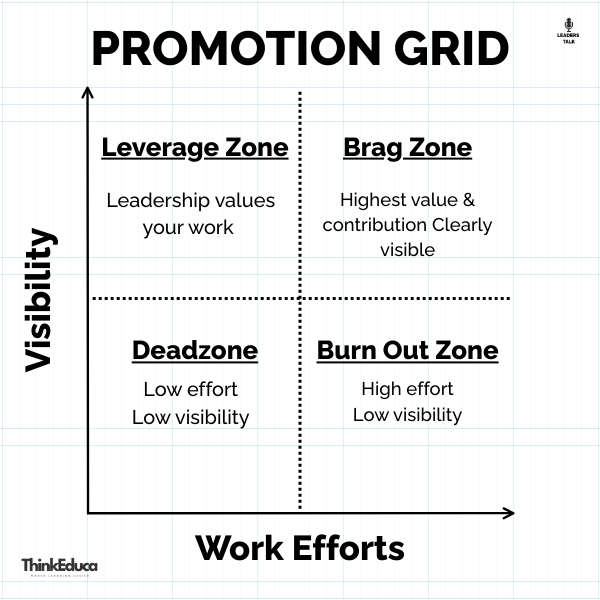
Once you understand this grid, you’ll immediately see: Why some people burn out, Why some stay invisible, And why a few rise fast without working themselves to death.
Now let’s break down what really happens in each zone.
Quadrant 1: Dead Zone: Low Effort, Low Visibility.
People in the Dead Zone: Do only what’s assigned, Avoid responsibility, Stay invisible by choice.
They don’t cause problems but they don’t create value either.
How Leadership Sees This Zone: From a manager’s perspective: No initiative, No ownership, No leadership signal. First to go in layoffs.
Even if these employees stay for years, they’re rarely considered for: Raises, Promotions, Important projects.
You don’t get promoted for not failing. You get promoted for contributing.
Quadrant 2: Burnout Zone: High Effort, Low Visibility.
This is where most employees live and suffer.
People here: Work extremely hard, Always say yes, Stay late, Fix problems quietly.
They’re dependable but invisible.
Leadership often thinks: “They’re strong executors. Let’s keep them right there.”
Why This Zone Is Dangerous: Effort isn’t translated into value, Results aren’t clearly communicated, You become useful but replaceable.
What This Zone Leads To: Burnout, Frustration, Stagnant salary.
Hard work without visibility doesn’t lead to promotion it leads to exhaustion.
Quadrant 3: Leverage Zone: Moderate Effort, High Visibility.
This is where careers start accelerating.
People in the Leverage Zone: Focus on high-impact work, Communicate outcomes clearly, Solve problems leadership actually cares about.
They don’t do everything. They do the right things.
Why Leadership Rewards This Zone: Because leadership thinks:“This person understands what matters.”
Their work:Is visible, Is appreciated, Is rewarded.
This is where: Trust builds, Bigger responsibilities come, Promotion conversations begin.
Quadrant 4: Brag Zone: High Effort, High Visibility.
This is the promotion fast track.
Important Clarification: “Brag Zone” doesn’t mean arrogance.
It means: High contribution, Clear ownership, Confident communication of result.
Constant updates and self-promotion that scream “needy,” eroding trust long-term.
People here: Influence decisions, Improve systems, Lead without authority.
Leadership doesn’t ask: “Should we promote them?”
They ask: “How fast can we move them up?”How People Move Up the Grid (This Is Key).
You don’t escape the Burnout Zone by working harder. You escape it by working smarter and more visibly.
That’s where the LAZY Method comes in.
5. The LAZY Method.
LAZY doesn’t mean doing nothing or careless. It means maximum impact with minimum wasted effort. LAZY stands: L — Leverage, A — Analyze (or Automate), Z — Zoom Out, Y — Yield Results. Let’s break each one down.
L — Leverage Your Existing Work.
Instead of adding work: Extract insights from what you already do.
For Example: You answer customer calls every day.
Most people: Answer calls, Solve the issue and Move on.
Leveraging means: Noticing repeated problems, Understanding customer pain points.
Same job. More value.
A — Automate or Analyze (From Answering Phones to Data Analytics).
This is the turning point, where ordinary employees become high-value employees.
You move from: “I handled calls” to:“Here’s what the data says”
What You Did: Logged call reasons, Tracked frequency, Identified patterns.
What You Became: A source of insights, A problem identifier, A decision supporter.
You moved from execution to analytics. That single shift moves you up the grid.
Z — Zoom Out (Think Like Leadership).
Leadership doesn’t think in tasks. Leadership thinks in: Cost, Risk, Efficiency and Scale.
Zooming out means asking: Why does this problem exist? What does it cost the business? What happens if we don’t fix it? It means: Connecting work to strategy, Understanding consequences, Thinking one level higher.
This mindset signals: “This person is leadership material.”
Y — Yield Measurable Results.
This is the final and most important step, where visibility happens. And that visibility comes from numbers. If you can’t measure it, you can’t sell it.
Always connect your work to: Time saved, Money saved, Revenue increased, Errors reduced and Customer satisfaction improved.
Instead of: “I worked really hard.” You say: “Repeat calls dropped by 25%.” “We saved 10 hours a week.”
Numbers move you from: Burnout Zone →(to) Leverage Zone →(to)Brag Zone.
6. How the LAZY Method Works?
- What You Did: Observed repeating problems, Collected simple data, Connected insights to outcomes.
- What Outcomes It Produced: Reduced workload, Improved efficiency, Management trust, Promotion discussions.
- What Problems It Avoided: Burnout, Being invisible, Being stuck in the same role, Being “replaceable”, Working hard with no reward.
Instead of doing more work, you created better work.
This is how people move from: Burnout Zone →(to) Leverage Zone →(or) Brag Zone
Why This Method Gets You Promoted Faster:
Because managers promote people who: Reduce chaos, Increase clarity, Improve results.
The LAZY Method: Makes you reliable, Makes you visible, Makes you valuable.
Final Advice (Very Important): Don’t wait for: Permission, Perfect timing or Recognition. Start behaving like the role you want.
Because promotions don’t change people, people change, then get promoted.
Why This Works for Earnings Too:
The LAZY Method increases earnings by shifting your work from effort-based tasks to value-based outcomes. When your work saves time, reduces costs, improves decisions, or increases revenue, your value becomes measurable. Measurable value makes salary discussions objective instead of emotional. Leaders don’t hesitate to pay more for people who consistently move results, not just tasks.
Because the fastest way to earn more…is to be worth more.
Conclusion:
Effort keeps you busy. Visibility makes you relevant. Value gets you promoted and paid more. The Promotion Grid shows where you are. The LAZY Method shows how to move up. So don’t aim to be the hardest worker in the room. Aim to be the most valuable. That’s how real career growth happens.