

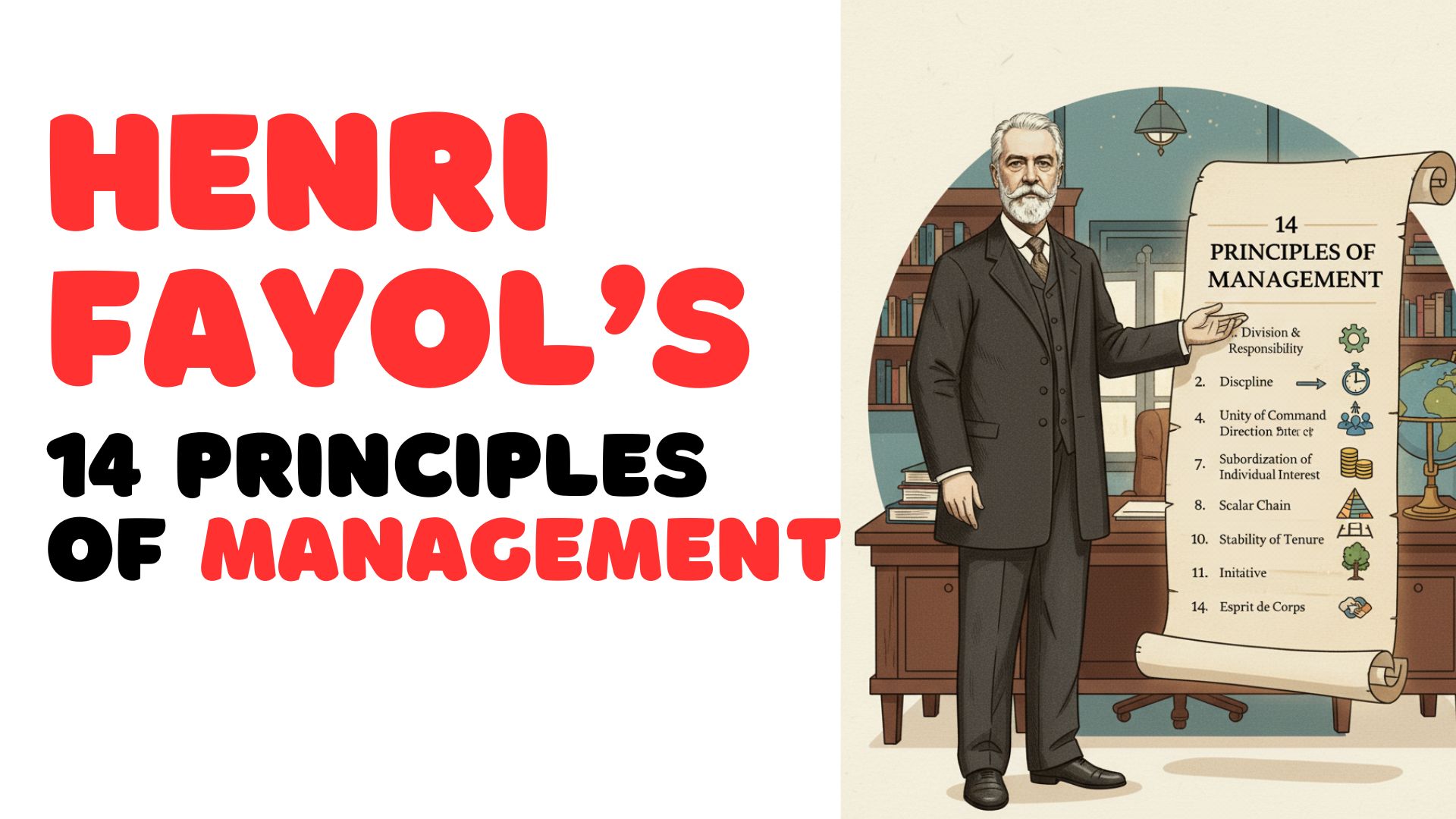
Here’s a little-known secret: the way your boss — and almost every manager in the world — runs things today was shaped over 100 years ago by one man, Henri Fayol. His 14 principles of management are still the ultimate blueprint for success.
Henri Fayol, often called the ‘Father of Modern Management,’ was a French mining engineer, author, and one of the earliest thinkers in management theory who didn’t just manage — he transformed the way we think about managing. Back in 1916, he introduced his 14 Principles of Management in his book ‘Administration Industrielle et Générale’.
While many management theories have come and gone, Fayol’s principles remain timeless. They are simple, practical, and can be applied in almost every organization — from startups to multinational corporations.
So, let’s break down these principles one by one with real-life examples you can relate to.
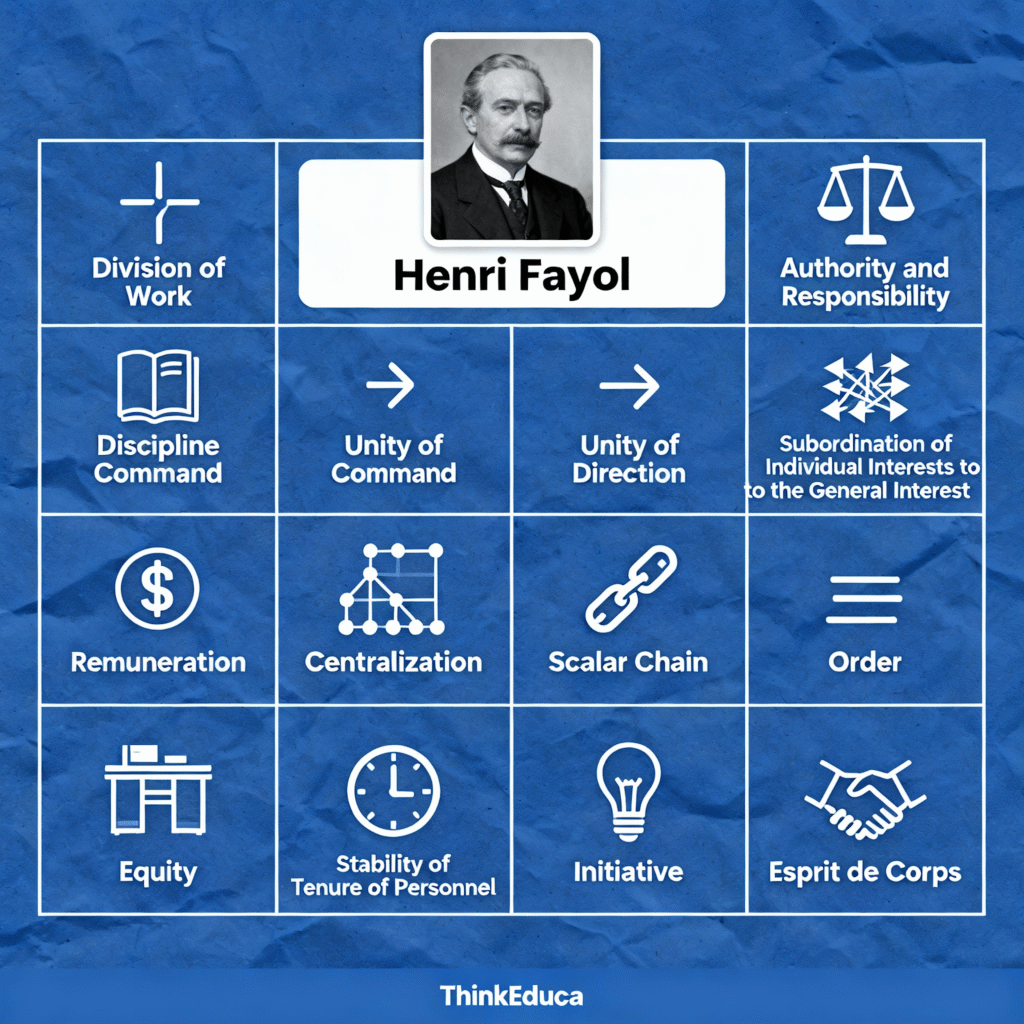
Principle 1. Division of Work:
When work is divided into smaller, specialized tasks, efficiency skyrockets. Specialization increases productivity. The more a person practices a specific task, the better they get at it.
For Example: Think of Amazon warehouses. One team picks, another packs, another ships. Nobody is juggling all tasks — specialization ensures speed and accuracy.
This principle is the reason your package can go from checkout to your doorstep in less than 24 hours.
Principle 2: Authority and Responsibility:
Authority gives managers the power to give orders. Responsibility ensures they’re accountable for results.
For Example: A project manager at Microsoft has the authority to assign tasks but must also take responsibility if the project fails. Without responsibility, authority can lead to misuse of power, and without authority, responsibility is meaningless — Fayol knew they must go hand in hand.
Principle 3: Discipline:
Discipline isn’t about punishment — it’s about respect for rules and agreements. Without discipline, no organization can function.
For Example: In the military, discipline is the backbone — soldiers follow strict codes of conduct to maintain order. In business, discipline can be seen in things like meeting deadlines, following company policies, and maintaining ethical practices. For instance, Airlines depend on strict discipline — from pilots, ground staff, and cabin crew — to keep passengers safe.
Principle 4: Unity of Command:
This principle states that every employee should receive orders from only one boss. If a worker reports to two managers, confusion is guaranteed.
For Example: Imagine you’re a marketing executive, and one manager tells you to launch a campaign, while another tells you to cancel it. Confusing, right? That’s why Fayol insisted on one clear line of command.
Companies like Apple follow this — every department has a head, and employees report to their direct manager, ensuring no conflicting instructions.
Principle 5: Unity of Direction:
While unity of command is about reporting, unity of direction is about focus. All activities with the same objective should be directed by one plan.
For Example: Tesla’s mission is to accelerate the world’s transition to sustainable energy. Whether it’s electric cars, solar panels, or battery technology, all teams work in the same direction under one plan.
Principle 6: Subordination of Individual Interest to General Interest:
In any organization, the collective goals of the company must take priority over personal ambitions. When individuals put their own desires ahead of the organization’s mission, it can disrupt teamwork and harm long-term growth.
For Example: A football player may want to scorea goal, passing the ball to a teammate at the right time ensures the team’s overall victory.
The same applies in the corporate world—an employee might seek a quick promotion, but if achieving it means cutting corners and damaging the company’s reputation, the short-term gain is not worth the long-term loss.
Modern companies like Google emphasize this principle by fostering a culture where collaboration, shared innovation, and team success are valued more than individual competition. This ensures that employees work toward the greater purpose of the organization, aligning personal goals with collective progress.
Principle 7: Remuneration to Employees:
Fair pay is essential to keep employees motivated.
For Example: Take Costco, Unlike many retailers, they pay above-average wages and offer benefits to workers. This results in higher loyalty, lower turnover, and better service. Compare that to competitors with constant hiring problems. Fayol was ahead of his time in recognizing that fair rewards drive long-term productivity.
Principle 8: Centralization and Decentralization:
Centralization refers to the concentration of decision-making power at the top levels of management, while decentralization distributes decision-making authority across various levels of the organization. Striking the right balance between the two is essential for efficiency and growth.
For example: in a startup, decision-making is usually highly centralized—the founder or CEO makes most of the key choices to maintain control and set direction. However, as companies expand, decentralization becomes necessary. Large corporations like Amazon delegate significant decision-making authority to regional managers or team leads so they can respond quickly to local challenges and customer needs.
The ideal level of centralization or decentralization depends on factors like the size of the organization, the nature of the work, and the capabilities of employees. Effective managers ensure decisions are made at the level where they can be most informed, efficient, and impactful.
Principle 9: Scalar Chain (Line of Authority):
A clear hierarchy avoids confusion. Communication should follow the chain of command (from top management to the lowest rank) but allow flexibility when needed.
For Example: In Infosys, communication flows CEO → Vice Presidents → Managers → Employees. But when speed is critical, Fayol suggested a shortcut — a ‘Gang Plank’. Imagine two mid-level managers cutting through hierarchy to solve a problem instantly. That’s smart flexibility.
Principle 10: Order:
Order means having a proper place for everything and everyone.
For Example: In Amazon warehouses, products are organized using advanced systems so that workers can pick and ship items quickly.
Similarly, in human order, the right person should be in the right job. A skilled IT engineer shouldn’t be placed in customer service just because there’s a vacancy.
Principle 11: Equity:
Equity is about fairness, kindness, and justice in the workplace.
For Example: Starbucks has built its brand not just on coffee but on equity — offering benefits and inclusivity across employees globally. Equity builds loyalty stronger than any paycheck alone.
Principle 12: Stability of Tenure of Personnel:
High turnover hurts productivity. Stability builds expertise.
For Example: Toyota invests heavily in employee retention, resulting in experienced staff who maintain high-quality production.
Fayol knew that employees perform better when they feel secure in their jobs.
Principle 13: Initiative:
Employees should be encouraged to take initiative and suggest improvements.
For Example: Think of Google’s famous ‘20% time policy’, where employees could spend 20% of their time on personal projects. That policy gave birth to Gmail and Google Maps! When employees feel trusted to take initiative, they create the future.
Principle 14: Esprit de Corps (Team Spirit):
The final principle emphasizes teamwork and unity.
For Example: Toyota practices this through its ‘Kaizen’ philosophy, where employees work together to improve processes continuously.
When people feel like part of a team, they work harder, support each other, and drive the company forward.”
Conclusion:
And there you have it — Henri Fayol’s 14 timeless principles of management.
They may have been written over a century ago, but look at any successful organization today, you’ll see these principles quietly working in the background.
And here’s the takeaway: management isn’t about controlling people; it’s about creating systems, fairness, and motivation that allow people to thrive together. Apply even a few of these principles, and you’ll see the difference in your own projects, career, or business. For a more in-depth exploration of this topic, please visit ThinkEduca.com, where you will find detailed guides and resources.