

Every organization has smart people. Every team works hard. Yet the same problems keep showing up — quarter after quarter. Targets slip. People disengage. Decisions don’t stick. The issue isn’t effort. The issue isn’t talent. The issue is where leaders choose to solve problems. Most leaders stop at what went wrong. They fix what’s visible. They react to what’s urgent. They fight fires all day. But great leaders go deeper — to why the system keeps producing the same result.
Picture yourself stuck in traffic. Cars are barely moving. Horns are blaring. Everyone is frustrated. Most people blame: The car in front, The signal timing and Bad drivers.
But a city planner looks at the same traffic jam and asks: “What design choices are causing this congestion every day?” Is it poor road planning?or Bad signal coordination?The difference is perspective. Drivers react to the jam. Leaders redesign the roads. That shift — from reacting to the event to rethinking the system is exactly why great leaders solve problems at a deeper level.
Today, let’s break down why great leaders solve problems at Level 4, not Level 1 — and how this one shift can completely transform your leadership, your team, and your results, through the Iceberg Model of Systems Thinking.
1. The ICEBERG Principle In Leadership:
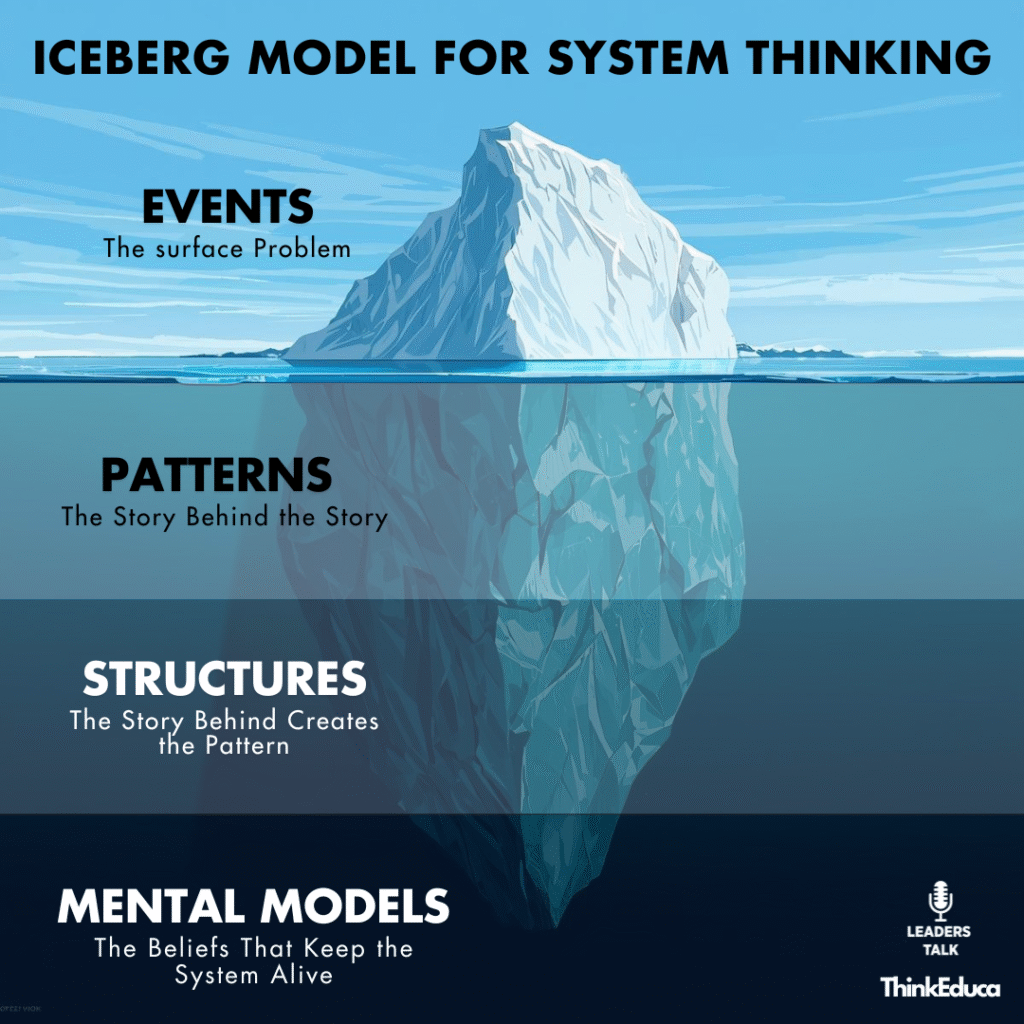
The difference between managing events and leading systems. The Iceberg Model explains this perfectly. Think of any leadership problem like an Iceberg.
What you see above the water is small, only 10 to 15%. What drives it below the surface is 85 to 90% massive.
What sinks organizations is not what they see —it’s what they never question.
The Iceberg Model helps us see this clearly. Let’s break it down level by level.
Level 1: Events – What Just Happened?
Events are the symptoms.
Like: “Sales dropped this month.”, “A top performer resigned.”, “A customer escalated.”,”Employee conflicts.”etc.
This is where most leaders react. Meetings are called. Emails are sent. Pressure increases. And yes — action happens.
But here’s the problem: Events are outcomes, not causes.
Fixing them feels productive, but it rarely creates lasting change.
For Example: A customer complains loudly on social media.
Typical Level-1 Leadership Response: Apologize quickly, Offer a refund, Blame the frontline employee and Move on.
Problem “solved”… right? Not really. Because next week, another customer complains.
Level 1 solutions are reactive. They treat symptoms, not causes.
Level 2: Patterns – What Keeps Happening?
Now we go one level deeper. And ask: “Is this a one-time incident — or a recurring trend?”
Patterns show up when: Sales dip every festive season, The same team struggles every year, Decisions fail repeatedly after meetings, Conflicts arise in the same situations.
Patterns tell leaders something important: This problem is not random. This is a designed outcome, and it’s predictable.
For Example: Customer complaints aren’t random — they spike every month-end.
Typical Level-2 Response: More monitoring, More rules, More meetings, More pressure.
This is better than Level 1…But still not leadership at its best.
Why?Because patterns don’t exist on their own. Systems create patterns.
Level 3: Structures – What System Creates This?
Now leadership becomes strategic.
Structures are the mechanics that shape behavior: Processes and workflows, Incentives and KPIs, Training systems, Approval chains, Communication norms.
For example:
Customers delay purchases because your pricing calendar trains them to wait for discounts.
New hires struggle because onboarding is informal: “Just shadow someone.” Teams clash because decision authority is unclear.
Structures are like plumbing. You don’t see them —but they decide where pressure builds and where leaks happen.
Fixing structure improves results. But it still doesn’t explain why those structures existed in the first place.
Level 4: Mental Models – Why Did We Design It This Way?
Mental models are the beliefs leaders operate from.
Mental models are: Assumptions leaders hold, Beliefs about people, Definitions of success, Unspoken rules.
Things people rarely say aloud, but behave as if they were true. They sound like:“Control ensures performance”, “Speed matters more than quality”,
“Leaders must have all the answers”, “Disagreement is a threat”
These beliefs quietly shape: Structures, That create patterns, and That produce events.
Change the belief — and everything else changes automatically.
Fixing events treats symptoms, Fixing patterns manages history, Fixing structures improves systems, Fixing mental models transforms outcomes.
This is why great leaders work at Level 4.
For Example: Missed Deadlines: Let’s connect this to a real-world leadership scenario.
Event: Projects are constantly late.
Level-1 Fix: Push the team harder. Work weekends. Send warning emails. Short-term delivery improves. Burnout increases.
Level-2 Insight: Deadlines are missed every quarter. This isn’t bad luck. It’s a pattern.
Level-3 Structure: Timelines are decided by leadership alone, No buffer for unexpected work, Teams aren’t involved in planning.
Level-4 Truth: Leadership believes: “If we ask for input, things will slow down.”
That belief creates rushed planning. Rushed planning creates missed deadlines.
The real problem isn’t execution. It’s the mindset.
Level-4 Solution: Great leaders: Change the belief from “speed” to “clarity”, Involve teams early, Reward honest timelines, Value sustainable performance.
Result? Deadlines improve without pressure.
2. Why Most Managers Get Stuck At Level 1:
Because Level 1 feels urgent. A problem appears. Pressure rises. The instinct is: “Fix it now.”
Typical responses: Call emergency reviews, Ask people to “be careful next time”, Push extra hours or manual checks. It feels productive, because fires are being put out. But nothing fundamental changes.
So the same fire returns —different day, different label.
Leaders get trapped in endless firefighting, leaving no time for strategy, capability building, or innovation.
The 5 Whys To Reach Level 4:
Great leaders use a simple but powerful tool: the 5 Whys.
They refuse to stop at the first answer. They ask “why” until they reach belief.
For Example: Imagine: “A key client project missed its deadline”.
Step 1 – Event → Pattern.
Why1. Why was the project late?
– Because the team received requirements very late.
Why2. Why were requirements late?
– Because sales promised a date before scoping was finished and kept changing specs.
Here you start to see a pattern of late, changing requirements across projects, not just this one.
Step 2 – Pattern → Structure.
Why3. Why can sales promise dates before scoping?
– Because there is no standard process requiring tech sign‑off before committing to the client.
Why4. Why is there no such process?
– Because sales targets and rewards are only tied to closing deals, not to delivery success.
Now you are at structure: missing cross‑functional process and misaligned incentives.
Step 3 – Structure → Mental models.
Why5. Why are targets designed this way?
– Because leaders believe “revenue first; delivery will somehow manage,” and assume coordination is a detail, not a strategic priority.
This exposes the mental model: revenue is valued more than reliable delivery.
By using the 5 Whys to move from events down to structures and mental models, great leaders permanently change the system instead of repeatedly fighting the same fires. Solve that belief — and performance improves.
3. How Level-4 Leaders Solve Problems Differently:
Great leaders don’t skip levels —They work across all levels — deliberately.
- Stabilize the event: Address today’s issue without blame. Support active deals and communicate clearly with stakeholders.
- Identify the pattern: Look across time, not just moments. Gather customer feedback and call data.
- Redesign the structure: Change incentives, workflows, ownership.
- Challenge the mental model: Ask: “What belief needs to change?”
This is slower at first —but dramatically faster over time.
Why Level 4 Leadership Creates Lasting Impact:
Because: Beliefs shape behavior, Behavior shapes systems, Systems shape results.
Solve at Level 1 → temporary relief.
Solve at Level 4 → lasting change.
One Level-4 change can eliminate dozens of future Level-1 problems. That is why great leaders solve problems at level 4, not level 1. They don’t just put out fires; they redesign the entire forest so it is far less flammable.
Conclusion:
Here’s the leadership truth: Problems don’t repeat because people don’t care.
They repeat because leaders solve them too shallow.