

Imagine you’re the captain of a ship. The sea is unpredictable, storms are coming, and your destination is months away. Now, ask yourself—would you rather have a crew that’s half-asleep, unskilled, and unmotivated… or a crew that’s skilled, passionate, and ready to face any wave? The truth is, your team determines whether your ship reaches the shore or sinks halfway. And in the new era of business—where change happens overnight—building the right crew is not just important… it’s survival.
Here’s what most leaders get wrong: They treat all team members the same. Big mistake. Research shows that in any team, you have exactly four types of people, and each type needs a completely different approach.
Today, I’m going to show you exactly how to build a high-performing team in the modern workplace… and how to categorize every team member into one of four quadrants based on capability and commitment, and most importantly, what to do with each type so you can build a team that wins consistently.
1: Why Building a High-Performing Team in the New Era is Different.
Before we dive into the framework, let’s talk about why team building has become so much harder in the new era. In the past, leaders focused mostly on capability — “Is this person skilled enough?”
Now, we know that capability alone doesn’t guarantee success. You also need commitment — the willingness to show up, push hard, and contribute to the team’s goals. So we’re living in what I call the “Capability-Commitment Crisis.” Remote work has made it harder to gauge commitment. Skill requirements change faster than ever. Reed Hastings, CEO of Netflix, once said that keeping one wrong person on your team is like having a virus that slowly kills the entire organization.
Consider this: A single disengaged employee can reduce team performance by up to 54%. That’s not just one person underperforming – that’s one person dragging down everyone else.
Meanwhile, companies like Google have discovered that just 20% of their workforce generates 80% of their breakthrough innovations. The difference? They’ve mastered a systematic approach to categorizing and managing four distinct types of team members.
2. The Capability–Commitment Quadrant Framework.
A high-performing team is no longer about just having smart people—it’s about having the right mix of skills and commitment that can adapt and thrive.
And the best way to figure that out? The Capability–Commitment Matrix or Skill-Will, and it’s built on two critical dimensions:
- Y-axis: Capability: This is about skills, knowledge, experience, and the ability to deliver results. Can this person actually do the job at the level required?
- X-axis: Commitment: This is about motivation, engagement, cultural fit, and willingness to go the extra mile. Does this person truly care about the success of the team and organization?
When you plot these two dimensions, you get four distinct quadrants, each combination creates a different type of team member that requires a totally different management approach.
And here’s the statistical reality across thousands of teams:
- 20% of your team are A-players (high capability, high commitment) —your future leaders.
- 70% are B-players (strong in one dimension, weaker in the other).
- 10% are C-players (low in both dimensions) —potentially dead weight.
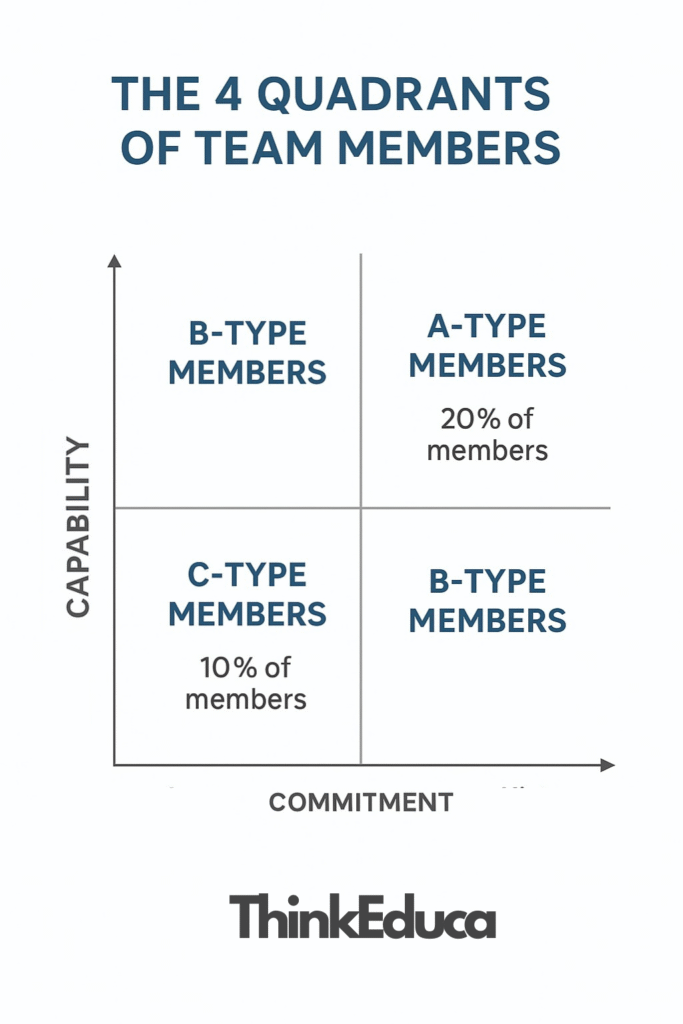
Let’s decode each quadrant, discuss what to do, and see it play out in real life
1. Quadrant 1: The Toxic 10% C-Type:
C-type team members demonstrate low capability and low commitment. While they represent only 10% of most teams, their impact on organizational performance is disproportionately negative.
The C-Type Profile:
- Consistently miss deadlines and quality standards.
- Make excuses instead of taking ownership.
- Spread negativity and complain constantly.
- Resist feedback and refuse to improve.
- Require constant micromanagement.
For Example: The Enron Warning.
Remember Enron? One of the factors in their collapse wasn’t just executive fraud – it was their tolerance of C-type employees throughout the organization. They had people who were both incompetent at risk management AND uncommitted to ethical standards. Instead of removing these toxic influences, they promoted some of them to senior positions. The result? A culture where poor performance and low integrity became normalized, contributing to one of the biggest corporate disasters in history.
Action Plan for C-Type Members: Fire them. Harsh? Maybe. Necessary?
Phase 1: Documentation (Week 1):
- Set crystal-clear performance expectations in writing.
- Establish specific, measurable deadlines.
- Document every conversation and missed commitment.
Phase 2: Final Opportunity (Weeks 2-6):
- Implement a 30-day performance improvement plan.
- Provide necessary resources and support.
Phase 3: Decisive Action (Week 7):
If significant improvement hasn’t occurred despite support and resources, make the difficult but necessary decision to part ways. This protects team morale and organizational standards.
Netflix has a famous “Keeper Test.” They ask managers: “If this person came to me and said they were leaving for a similar job, would I fight to keep them?” If the answer is no, that person shouldn’t be on the team.
Remember: Keeping C-type employees isn’t compassionate – it’s actually unfair to everyone else who’s working hard and delivering results.
Quadrant 2: Motivated but Inexperienced B-Type:
Now we move to the first type of B-player: high commitment but currently low capability. These are your hidden gems – people with the right heart who just need the right development.
The High-Commitment, Low-Capability Profile:
- Enthusiastic and positive attitude.
- Willing to put in extra effort.
- Coachable and open to feedback.
- Strong cultural fit.
- Currently lacks specific technical skills or experience.
For Example: Southwest Airlines is famous for this approach. Their motto “Hire for attitude, train for skill” has enabled them to maintain profitability for over 40 consecutive years – a record unmatched in the airline industry.
When Herb Kelleher was CEO, Southwest would often hire people with zero airline experience but incredible customer service commitment. One famous example is Colleen Barrett, who started as a secretary and became Southwest’s President and COO. She had low capability initially but incredibly high commitment. Southwest invested in her development, and she became instrumental in building their legendary culture.
The Development Strategy: Support, Develop, or Exit if No Progress.
Step 1: Capability Assessment (Week 1).
Honestly evaluate: Can this person realistically develop the required skills? Some gaps are too large, and it’s better to be realistic upfront.
Step 2: Intensive Development Program (Months 1-3).
- Pair them with your A-players as mentors.
- Invest in targeted training and certifications.
- Create stretch assignments that build skills progressively.
- Provide weekly coaching and feedback sessions.
Step 3: Progress Tracking: Set specific milestones at 30, 60, and 90 days. Track both skill development and continued commitment levels.
Step 4: Decision Point (Month 4): Two outcomes are possible:
Success: They’ve developed sufficient capability and become A-players.
Redirection: Despite great attitude, if they can’t reach the required capability, help them find a role better suited to their skills or let them go.
The key insight: Commitment can’t be taught, but capability often can be. Don’t give up on these people too quickly, but also set clear timelines and expectations.
Quadrant 3: Talented but Disengaged B-Type:
This quadrant presents both significant opportunity and substantial risk. These individuals possess the skills to drive exceptional results but lack the engagement to consistently deliver their potential.
The High-Capability, Low-Commitment Profile:
- Demonstrates technical excellence in core responsibilities.
- Delivers minimum required work without additional effort.
- Shows limited enthusiasm for team initiatives or company goals.
- May express cynicism about organizational direction.
- Capable of high performance but inconsistent in delivery.
- Potential flight risk to competitors offering better opportunities
For Example: Apple’s Transformation Under Steve Jobs.
When Steve Jobs returned to Apple in 1997, the company was filled with talented engineers and designers who had become disengaged under ineffective leadership. Rather than replacing the entire team, Jobs implemented a strategic re-engagement approach( The Two-Pronged Approach).
His method involved two key elements: recognition and challenge. He publicly acknowledged the team’s technical expertise while simultaneously challenging them with audacious goals like creating the iMac, iPod, and eventually the iPhone. This approach transformed a demoralized group of talented individuals into the team that built the world’s most valuable company.
Re-engagement Strategy:
1.Recognition Phase (Weeks 1-4):
- Publicly acknowledge their expertise and past contributions.
- Seek their input on strategic decisions and technical challenges.
- Ensure compensation reflects their market value and contribution.
- Provide visibility with senior leadership and key stakeholders.
2.Challenge Phase (Weeks 5-12):
- Assign high-impact, intellectually stimulating projects.
- Provide leadership opportunities in areas of interest.
- Set stretch goals that fully utilize their capabilities.
- Offer professional development in emerging technologies or markets.
3.Monitoring and Assessment (Month 4):
Track engagement indicators: voluntary contributions, collaboration quality, attitude in meetings, and overall energy levels. Significant improvement should be evident within 90 days.
Quadrant 4: The High Performers A-Type:
Finally, we reach your championship team – the golden 20% who have both high capability and high commitment and drive 60 to 80% of breakthrough results and innovation. These are your A-players, and how you manage them determines whether you build a great organization or watch your superstars leave for competitors.
The A-Type Profile:
- Consistently exceed performance expectations.
- Self-motivated and proactive in identifying opportunities.
- Positive influence on team culture and morale.
- Continuously seek learning and growth opportunities.
- Take ownership of both successes and failures.
- Natural mentors who develop others’ capabilities.
For Example: Amazon’s Leadership Development System.
Amazon is legendary for identifying and developing A-players systematically. Take Andy Jassy’s journey: he went from a high-performing business analyst to leading a small team, then building AWS from scratch, and eventually becoming CEO of the entire company.
Jeff Bezos didn’t just recognize Jassy’s performance – he systematically elevated him through increasingly challenging roles, each one developing new capabilities while leveraging his proven commitment.
The A-Player Management System:
1.Recognition and Reward (Ongoing):
- Provide both public recognition and meaningful private appreciation.
- Ensure total compensation reflects their outsized contribution.
- Offer first access to new opportunities, projects, and resources.
2.Strategic Elevation (Quarterly):
- Promote before they request advancement (and before competitors recruit them).
- Include in strategic planning and high-level decision-making processes.
3.Leadership Development (Annually):
- Assign mentoring responsibilities with developing team members.
- Grant hiring authority and team-building opportunities.
4.Retention Strategies (Continuous):The cost of losing an A-player is enormous – not just their individual contribution, but their influence on others and the knowledge they take with them.
- Conduct regular career development conversations.
- Provide competitive compensation packages including equity participation.
- Create clear advancement pathways with specific milestones and timelines.
Critical Warning: Your biggest mistake would be neglecting A-players because “they don’t need attention.” High performers often become disengaged when they feel taken for granted or see their growth stagnating.
3. Implementation Roadmap:
Transforming your team using the Capability-Commitment Matrix requires systematic implementation with clear timelines and measurable outcomes:
Week 1: Comprehensive Team Assessment:
- Create confidential individual assessments for each team member.
- Rate each person on capability (1-10) and commitment (1-10).
- Plot them on the matrix.
- Be brutally honest – this initial assessment is for your eyes only.
Week 2: Create Individual Action Plans:
- Develop specific strategies for each person based on their quadrant.
- Set specific, measurable objectives and timeline expectations.
- Identify who needs immediate attention (C-types and flight-risk A-types).
Weeks 3-4: Begin Execution:
- Start with your C-types (performance improvement plans).
- Launch development programs for high-commitment, low-capability B-types.
- Implement credit and challenge strategies for disengaged high-performers.
- Ensure A-types feel valued and challenged.
Ongoing: Monitor and Adjust:
- Weekly progress reviews.
- Monthly quadrant reassessments (people can and should move between quadrants).
- Quarterly strategy adjustments based on results.
The 90-Day Milestone: By day 90, you should see:
- C-types either dramatically improved or removed.
- B-types showing clear development progress.
- A-types more engaged and taking on leadership roles.
- Overall team performance and morale significantly improved.
Leadership Tips: Team members’ capabilities and commitment levels change over time. Regular reassessment ensures your management approach evolves with individual development. Use measurable KPIs for capability and clear behavioral markers for commitment.
Conclusion:
As underperformers are addressed and high performers are retained and developed, the overall team standard rises, attracting even stronger candidates and creating increasingly robust organisational capability.