

Leadership vs Management is like Netflix vs Wi-Fi… One gives you the dream, the other makes it actually play!
You might have heard a thousand times at work, in interviews, or even in leadership seminars: What’s the difference between leadership and management?
They seem alike—but in reality, they play very different, yet equally important roles in the success of any team or organization.
Here’s the truth:
Leaders set the destination. Managers design the map. And together—they make the journey possible.
Let’s start with,
1. What Is Leadership?
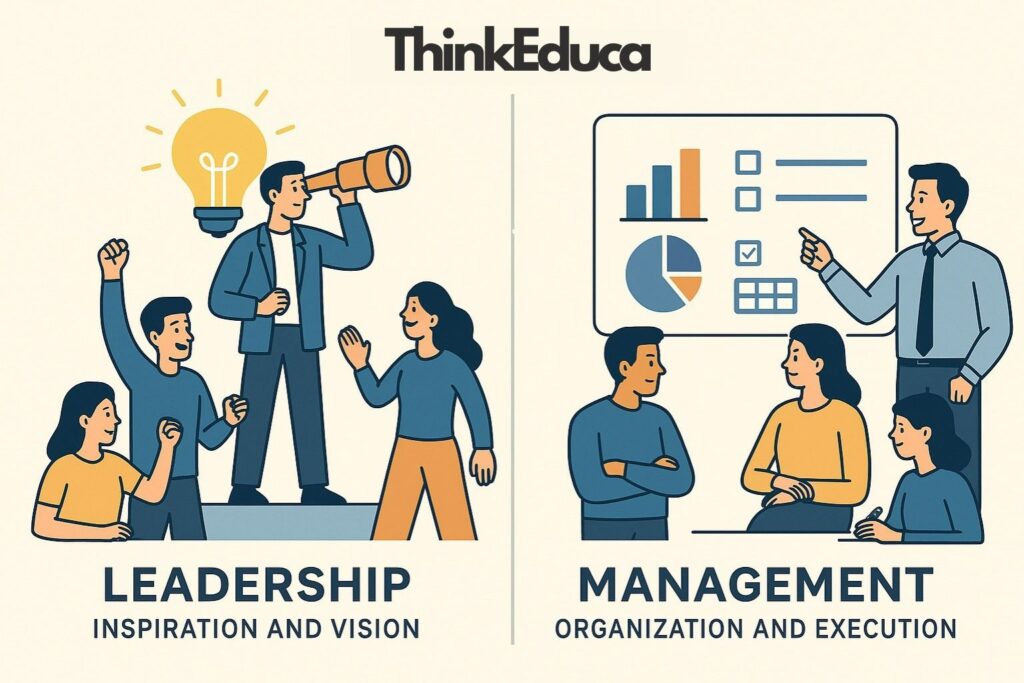
Leadership is not about job titles. It’s about influence, vision, and direction.
A leader is the person who says: ‘Here’s the mountain we’re climbing, They’re not always focused on how exactly we’ll get there—they’re focused on why it matters, and let’s go together!’
Think about Elon Musk. He painted a vision: ‘Humans will live on Mars.’
Now, whether you think he’s a genius or a meme machine, he INSPIRED thousands of engineers to work sleepless nights at SpaceX. That’s leadership—painting a vision so powerful that people want to follow.
Leaders don’t just tell you what to do — they make you WANT to do it. They talk about the future, they inspire to believe in something bigger than themselves.
Leaders are often described as change-makers and visionaries. They thrive in uncertainty because they’re focused on the big picture.
2. What is Management?
Management is the process of planning, organizing, and coordinating resources (people, money, time) to achieve specific objectives. A manager is the person who says: “Here’s how we’ll get there, step by step.” They deal with the HOW, the WHEN, and the WHO. Without great management, even the best leadership vision crashes and burns.
For Example: Tim Cook(world-class manager) at Apple. While Steve Jobs was dreaming of world-changing products, Tim Cook was building the most efficient supply chain on Earth. He optimized processes, and ensured every iPhone hit the market on time. That’s why Apple didn’t collapse after Jobs — because it had an incredible manager at the wheel.
So while leadership is about creating the vision…Management is about executing the vision.
3. Leadership vs Management – The Key Differences.
People often mix leadership and management because the best professionals balance both roles. But at their core, leadership and management play very different games. Let’s break it down in simple terms.
1. Leaders Set the Goal, Managers Follow It:
Leaders decide where the organization is heading. They set ambitious goals that define the destination. Managers, on the other hand, chart the route—breaking the vision into actionable steps, assigning tasks, and ensuring everyone stays on track.
Without the leader, there’s no clear destination. Without the manager, the team loses direction and momentum along the way.
For Example: Steve Jobs (Leader): envisioned a world where technology is beautiful, simple, and personal. Tim Cook (Manager): took that vision and made Apple the most efficient, profitable machine in history. Jobs set the goal. Cook made sure everyone followed it—down to the supply chain, production, and delivery.
2. Leaders Think Ideas, Managers Think Execution:
Leaders imagine what’s possible. They focus on the big picture and inspire others to follow them into new territory. Managers, meanwhile, transform those visions into reality by creating plans, organizing people, and ensuring things run smoothly day-to-day.
Without the leader, there’s no big idea. Without the manager, the idea dies after one episode.
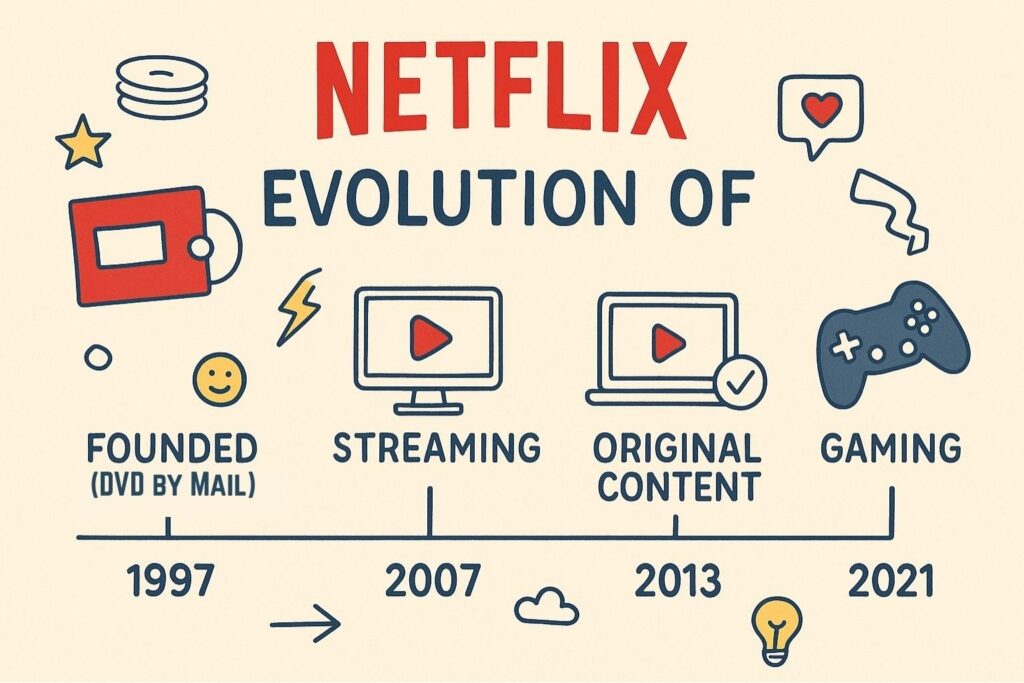
For Example: Netflix: Reed Hastings (leader) thought about changing how people watch TV forever. The management team figured out servers, licensing deals, and app performance so you could binge-watch Stranger Things without buffering.
3. Leaders Form the Culture, Managers Support It:
Culture is what people feel when they walk into your company. Leaders shape the values, beliefs, and mindset of an organization. They set the tone for how people think, behave, and collaborate. Managers then reinforce that culture by supporting teams, maintaining standards, and making sure daily actions reflect those values.
Without the leader, the culture lacks identity. Without the manager, the culture doesn’t sustain in practice.
For Example: At Google, Larry Page and Sergey Brin (leaders) established a culture of innovation, openness, and “thinking 10x bigger.” Google’s managers support this by fostering teamwork, running projects aligned with these values, and ensuring that creativity thrives without chaos.
4. Leaders Inspire People, Managers Push Them to Success:
Leaders inspire, motivate, and light a fire within their teams. They lead by influence, turning followers into fellow believers. They’re the ones giving those Monday morning “let’s change the world!” speeches.
Managers take that energy and provide the nudge—sometimes gentle, sometimes a necessary push. They coach, measure progress, give feedback, and make sure everyone gets across the finish line.
Without leaders, people lack the “why.” Without managers, that passion never turns into concrete success.
For Example: Netflix: Reed Hastings (leader) inspired his team with the belief that “We’re not just renting movies—we’re changing entertainment forever.” Managers then pushed teams to meet deadlines, optimize operations, and execute strategies that made binge-watching possible worldwide.
5. Leaders Speak Into the Future, Managers Act in the Present:
Leaders are futuristic storytellers. Always talk about where the organization is headed, painting a picture of the future and rallying people toward it. Managers focus on what needs to be done today—executing plans, solving immediate problems, and ensuring stability in the present.
Without leaders, the future is blurry. Without managers, the present falls apart.
For Example: Jeff Bezos (Leader): said, “We’re going to make Amazon the world’s most customer-centric company.” Amazon’s managers figured out how to deliver a toothbrush to your doorstep in under 24 hours.
One dreamed about the future. The other built systems to make it happen today.
6. Leaders Embrace Risk, Managers Minimize It:
Leaders step into the unknown, willing to take bold risks that could redefine the game. Managers, on the other hand, focus on stability—mitigating risks, setting safeguards, and ensuring the ship stays afloat.
Without leaders, there’s no breakthrough. Without managers, risks turn into chaos.
For Example: Jeff Bezos (leader) took the massive risk of transforming Amazon from an online bookstore into the “everything store.” Managers handled the logistics—warehousing, delivery systems, and process controls—to reduce errors and keep operations running smoothly.
4. Why Both Are Essential:
Great companies don’t choose between leaders and managers—they choose both. Both leadership and management are essential for organizational success. A company overflowing with leaders but no managers is all vision and no reality—like a band that endlessly dreams but never records an album. All managers and no leaders? You get efficient, organized spreadsheets but zero innovation or excitement. A good organization balances the visionary drive of leadership with the process-oriented discipline of management.
How To Balance Both: Here’s where it gets interesting: You don’t have to choose just one. In fact, the best organizations—and the best professionals—blend leadership and management skills together. Leaders need to learn project management and Managers need to learn how to inspire.
That’s why Satya Nadella and Indira Nooyi stand out — they know how to do both.
Tip: In your career, try to be the person who can dream big like a leader, but also execute like a manager. That combo? Unstoppable.
5. Case Study of : Netflix vs Blockbuster:
Let’s look at one of the most dramatic examples in business history – Netflix versus Blockbuster. This story perfectly illustrates the difference between management and leadership thinking. In the early 2000s, Blockbuster dominated video rentals with 9,000 stores worldwide and strong management systems. When Netflix’s Reed Hastings proposed a partnership, Blockbuster laughed and dismissed Netflix’s proposal with confidence; they were focused on managing the present, not envisioning the future. Hastings, however, asked: “What if physical stores vanish?” He envisioned streaming before others did. Result? Blockbuster went bankrupt in 2010, while Netflix became a $240 billion giant. Same industry, same customers, completely different outcomes. The difference? One company was managed brilliantly within an existing paradigm. The other was led toward a completely new paradigm.
6. Difference Table:
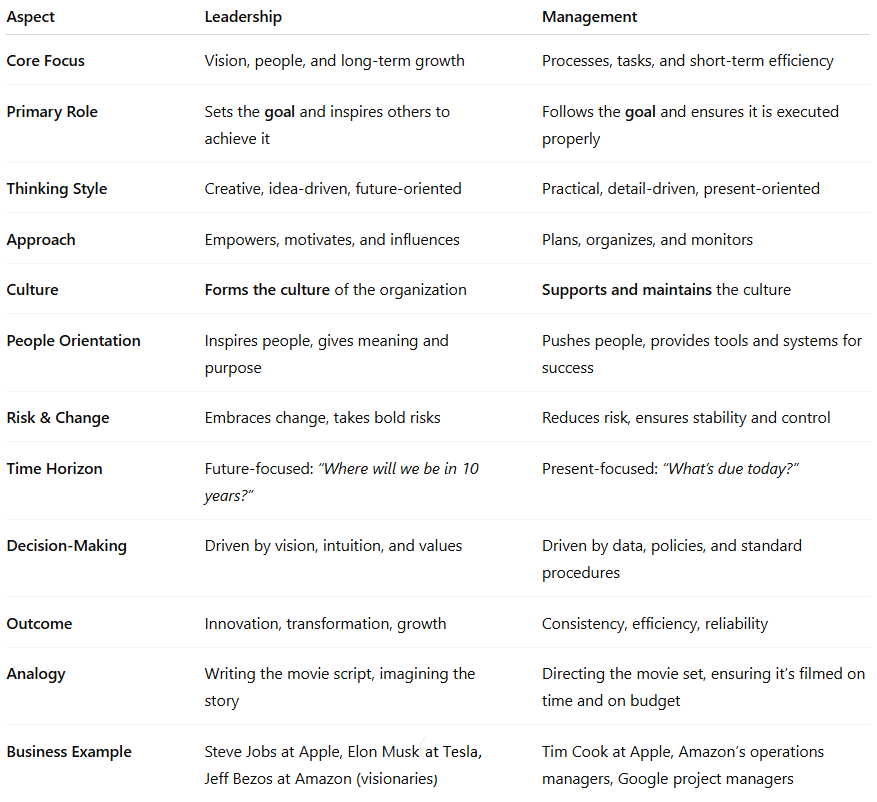
Alright, let’s wrap this up in a simple difference table you can screenshot.
Conclusion:
So, next time you hear someone confuse a manager with a leader, you’ll know: Leaders light the fire. Managers keep it burning. Both are heroes in their own right.
One without the other is incomplete. In business, careers, and even life, you need both.