

Markets change long before companies notice it. Rules shift before businesses prepare. And trends explode before most leaders even realize something is happening.
In every industry—tech, retail, entertainment—the winners aren’t just skilled…
They’re the ones who sensed the shift early.
And behind that early sense? A strategic tool that quietly guides the smartest companies on the planet: PESTEL Analysis—a tool that helps you see EVERYTHING happening outside your company…so you can survive, grow, and dominate.
1. Let’s begin with What Are External & Internal Environments?
Every organization lives inside two types of environments:
1. Internal Environment: Things inside the company: includes,
- Employees.
- Leadership.
- Culture.
- Processes.
- Resources.
- Company structure.
Your internal environment is what you can control.
For example: Netflix choosing to shift from DVDs to online streaming—that was an internal strategic decision.
2. External Environment: Things happening outside your company that you cannot control, but must understand. This includes:
- Government rules.
- Technology changes.
- Social trends.
- Economic conditions.
- Competitor movements.
- Customer expectations.
Your external environment is what you must analyze, prepare for, and adapt to.
This external landscape is where PESTEL, PEST, STEEPLE, DESTEP, and SPELIT come into play.
Before we go deeper, let’s define each framework shortly and clearly:
1.PESTEL: A framework to study Political, Economic, Social, Technological, Environmental, and Legal factors. Most comprehensive external environment model.
2.PEST : A simpler version: Political, Economic, Social, Technological.
3.STEEPLE: An expanded version that adds: Ethical considerations.
4.DESTEP: Starts with Demographic then → Economic → Social → Technological → Environmental → and Political.
5.SPELIT: Focuses on: Social, Political, Economic, Legal, Intercultural, and Technological.
These are all macro-environment tools, but PESTEL remains the most complete and widely used, so we’ll focus on that.
2. What is PESTEL Analysis?
PESTEL Analysis is a strategic tool used by businesses to understand the macro-environment — the big external forces that can impact an organization, industry, or market. It helps companies make smarter decisions, reduce risk, and plan for the future.
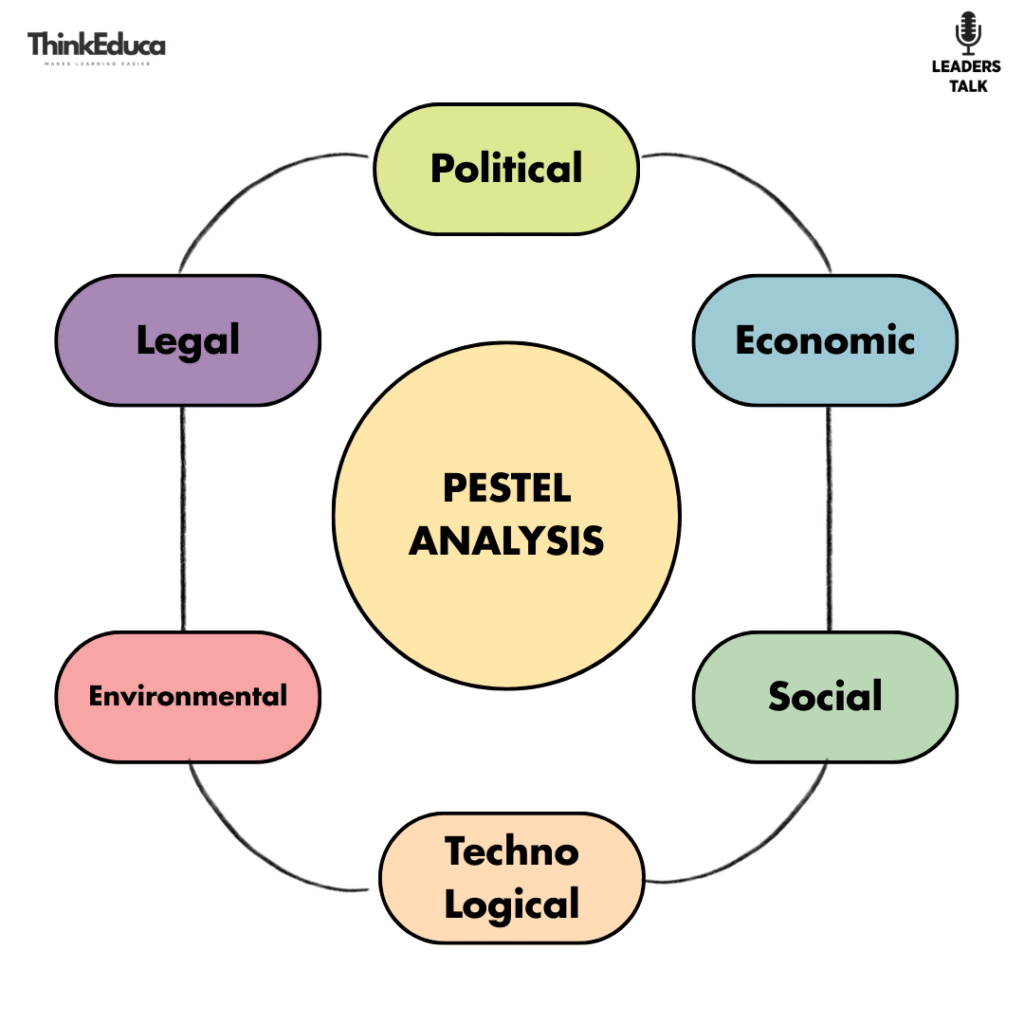
PESTEL stands for:
P – Political.
E – Economic.
S – Social.
T – Technological.
E – Environmental.
L – Legal.
Each of these factors represents a part of the external environment you cannot control, but must monitor.
Let’s break down these six factors in a simple and practical way.
1st. Political Factors: These are government-related influences that can affect business operations.
These include: Government policies, Tax regulations, Trade restrictions, Political stability, and Foreign trade agreements.
Why Political Factors Matter: Because one policy change can increase costs, open new markets, or even shut down entire industries.
Famous Example Everyone Knows: TikTok Ban.
When countries like India banned TikTok, millions of creators lost their platform instantly. At the same time, apps like Instagram Reels and YouTube Shorts grew massively. One political decision reshaped the entire digital content industry.
Political changes don’t ask for permission — they simply happen.
Which is why businesses continuously scan this environment.
2nd. Economic Factors: These determine how healthy the economy is, and directly affect consumer spending and company performance.
These include: Inflation, Interest rates, Exchange rates, Economic growth, Employment levels, and Consumer purchasing power.
Why Economic Factors Matter: Because economic shifts decide whether people buy more, buy less, or stop buying at all.
For Example: Everyone Knows 2008 Global Recession.
During the recession: People stopped buying cars, Housing markets crashed, Luxury brands struggled, But fast-food chains like McDonald’s (affordable meals) grew stronger.
When the economy changes, consumer behaviour changes — the entire business world adjusts with it.
This is why companies track economic trends before launching products or expanding.
3rd. Social Factors: These relate to cultural trends, lifestyle changes, and demographic shifts.
These include: Age distribution, Population growth, Attitudes toward health, work, or trends, Cultural beliefs, Education levels.
Why Social Factors Matter: Because customers behaviour decides what sells — and what doesn’t.
For Example: As people became more health conscious, demand increased for: Fitness apps, Smartwatches, Organic food, Gyms, Vegan products. Brands quickly adapted. Like Coca-Cola expanded Coke Zero in response to growing demand for low-sugar beverages, while companies like FitBit, MyFitnessPal, and various nutrition start-ups flourished because of shifting social preferences.
If society changes, businesses must change with it.
4th. Technological Factors: These cover technological innovation and the pace of change.
These include: Automation, Research & development, Artificial Intelligence, New communication tools, Digital transformation.
Why Technological Factors Matter: Because technology can wipe out old business models overnight.
For Example: Netflix versus Blockbuster: Netflix introduced online streaming technology. Blockbuster stayed stuck in traditional DVD rentals. The result? Netflix became a global giant, while Blockbuster disappeared.
Also E-commerce platforms like Amazon and Flipkart grew rapidly due to advancements in online payment systems and logistics tech.
Technology isn’t optional anymore — it’s survival.
5th. Environmental Factors: These relate to ecological and environmental aspects that affect industries.
These include: Climate change, Sustainability rules, Waste management requirements, Availability of natural resources.
Why Environmental Factors Matter: Because businesses are now expected to operate responsibly.
For Example: Automobile companies are shifting toward electric vehicles due to environmental concerns and carbon emission restrictions. A powerful illustration of this shift is Tesla’s Rise: As the world pushed for cleaner energy, Governments supported electric cars, Consumers demanded eco-friendly alternatives and Fuel costs kept rising. Tesla entered at the perfect time and became the face of the EV movement.
Environmental awareness isn’t just a trend — it’s shaping entire industries.
6th. Legal Factors: Legal factors include laws businesses must follow to operate safely and ethically.
These include: Labor laws, Consumer protection laws, Data privacy laws (like GDPR), Industry-specific regulations, Health & safety standards.
Distinguish from Political:
Political = who has power and what they want to do.
Legal = the actual rules and regulations in force.
Why Legal Factors Matter: Because breaking the law is expensive.
For Example: When governments tightened privacy laws (like GDPR), Facebook (Meta) had to Change its data policies, Increase transparency, and pay billions in penalties due to data misuse.
New privacy laws force companies to handle customer data responsibly — or face consequences.
Legal compliance is no longer optional — it’s a competitive advantage.
3. A Real-World Example That Ties Everything Together:
Let’s take Netflix, because everyone knows it—and it perfectly illustrates PESTEL in action. How Netflix used PESTEL to dominate the world:
Political: Different countries have different censorship rules → Netflix adjusts content.
Economic: Adjusted pricing based on country affordability.
Social: Recognized rising demand for binge-worthy originals → created House of Cards, Stranger Things.
Technological: Invested early in streaming tech and AI-driven recommendations.
Environmental: Reduced DVD waste by shifting digital.
Legal: Follows strict copyright laws globally.
Netflix didn’t win because they were lucky—they won because they understood their environment better than competitors. That’s the power of PESTEL.
4. How to actually do PESTEL:
- Define your objective: new country, new product, or strategic review.
- Gather information: news, reports, government sites, industry data.
- List factors under each PESTEL category that are relevant to your industry.
- Narrow down to the few that matter most (biggest impact or highest uncertainty).
- Discuss or score them with your team to see where risks and opportunities cluster.
- Translate insights into action: enter / avoid / adapt product / adjust pricing / lobby for regulation, etc.
Common mistakes:
- Making a long list but never using it.
- Being too generic (e.g., just writing “politics” instead of a specific policy).
- Forgetting to update the analysis when conditions change.
Conclusion:
The companies that survive aren’t the ones with the biggest budgets…They are the ones who understand the world around them, interpret the signals, adapt with intelligence, and lead with confidence.