

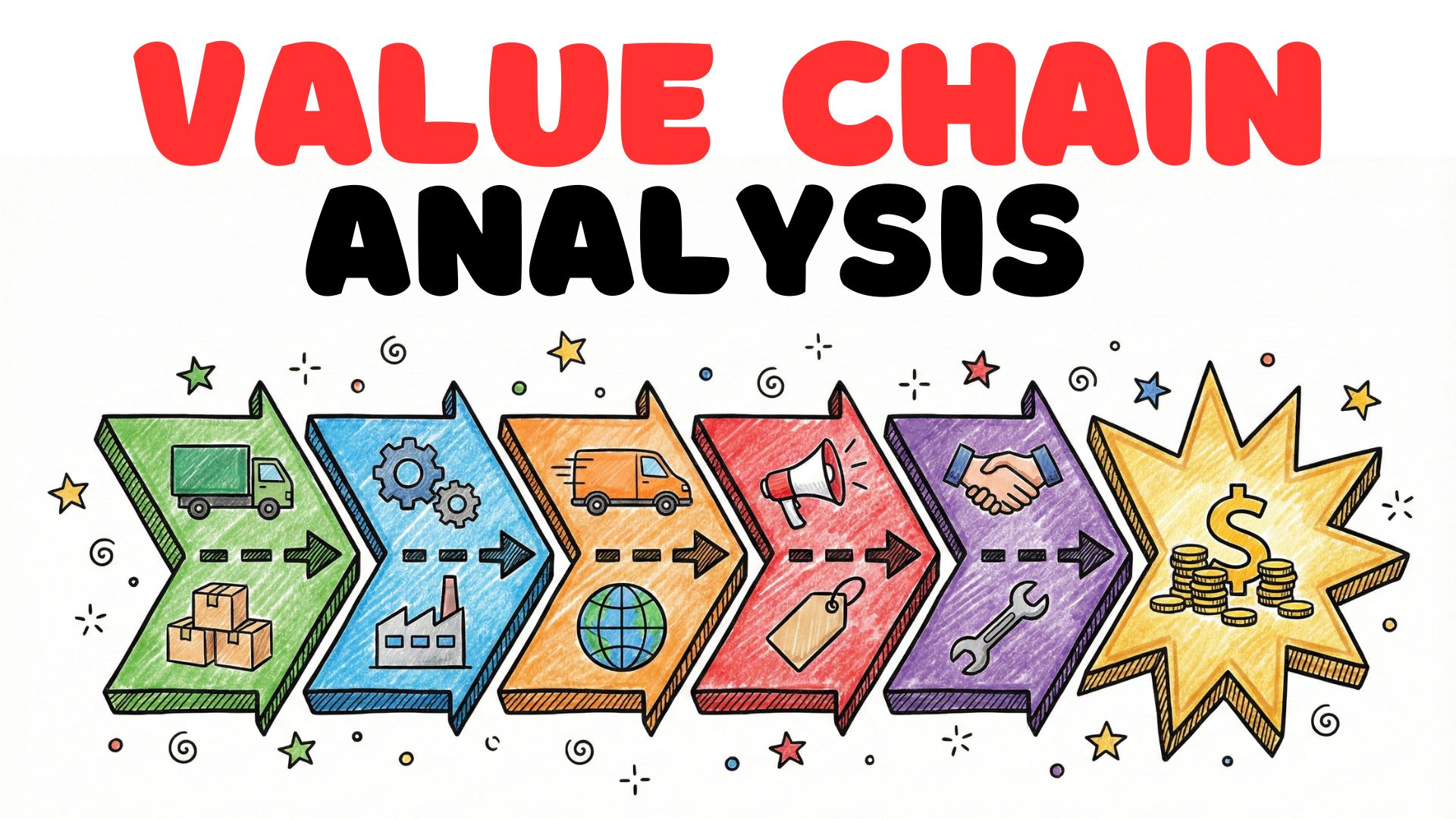
You know, in business, profit isn’t created by chance — it’s designed. From the moment a product idea is sketched on a whiteboard…to the moment it lands in a customer’s hands, every single step either adds value or adds cost.
That’s where Value Chain Analysis comes in. A framework behind the world’s most successful companies, from Apple designing your iPhone, to Starbucks brewing your coffee.
Welcome to the world of Value Chain Analysis — one of the smartest tools in business strategy. Let’s begin!
1. What is Value Chain Analysis?
The concept of the Value Chain was introduced by Michael Porter in his book Competitive Advantage (1985). At its core, Value Chain Analysis helps businesses understand how they create value — and where they can do it better.
Value chain analysis divides your business activities into two main categories: Primary Activities and Support Activities.
By examining these activities, companies can find opportunities to reduce costs, improve efficiency, differentiate their offerings, and maximize value for customers.
It involves mapping and evaluating every step in a company’s process, from the initial design, sourcing of raw materials, manufacturing, marketing, delivery, and after-sales support. The goal is to understand how value is added (or subtracted) at each stage, informing decisions to boost efficiency or product differentiation for strategic gains.
1.1. Why Is Value Chain Analysis Important?
Because in today’s competitive world, success isn’t about what you sell — it’s about how you create and deliver it.
- Improving Efficiency: It highlights inefficiencies in workflows, allowing businesses to streamline operations and reduce costs.
- Competitive Advantage: Clarifies how a company’s product or service stands out compared to competitors—either through cost leadership or differentiation.
- Strategic Insight: Facilitates strategic decisions around partnerships, outsourcing, product development, and market expansion by showcasing the most valuable activities.
- Customer Value: Enhances quality and satisfaction by focusing resources on activities that maximize customer value.
For example: Apple’s value chain allows them to build hype, deliver precision-engineered devices, and offer elite after-sales service—all helping them stay ahead of competitors.
And it’s not just about the big players. Every business, big or small, can use value chain analysis. Whether you run a supermarket, a shoe store, or a global tech company, understanding how each step contributes to your overall value can transform your results. It’s like having an X-ray view of your business — showing where value is built and where it leaks.
1.2.Value Chain vs Supply Chain:
Let’s clear up a big misconception: the value chain is NOT the same as the supply chain.
The Supply Chain focuses on how products move — from suppliers to customers. It’s about logistics, inventory, and delivery efficiency.
The Value Chain focuses on how value is created — through design, marketing, brand experience, and customer satisfaction.
In short: The Supply Chain is about movement. The Value Chain is about meaning.
Both are connected — but the Value Chain takes a strategic, customer-centered view of the entire business.
Think of it this way:
Supply Chain = Getting products to customers.
Value Chain = Making customers want your products.
For Example: Zara merges both brilliantly — it doesn’t just produce clothes fast (supply chain); it captures runway trends and delivers them to stores in weeks (value chain). That’s why Zara dominates fast fashion.
1.3. How the Value Chain Works:
Now let’s understand how the Value Chain actually works, from idea to customer satisfaction.
1. Design: Where the idea begins. R&D, product planning, and innovation happen here.
2. Produce: Manufacturing or operations — where raw materials become finished goods.
3. Market: Communicating value to customers through promotion and branding.
4. Deliver: Distributing the product efficiently to customers.
5. Support: Providing after-sales service, warranty, or upgrades.
Each stage adds a layer of value, and together they form your company’s Value Chain.
And all of this is supported by what Porter called Primary and Support Activities.
2: Porter’s Value Chain Model:
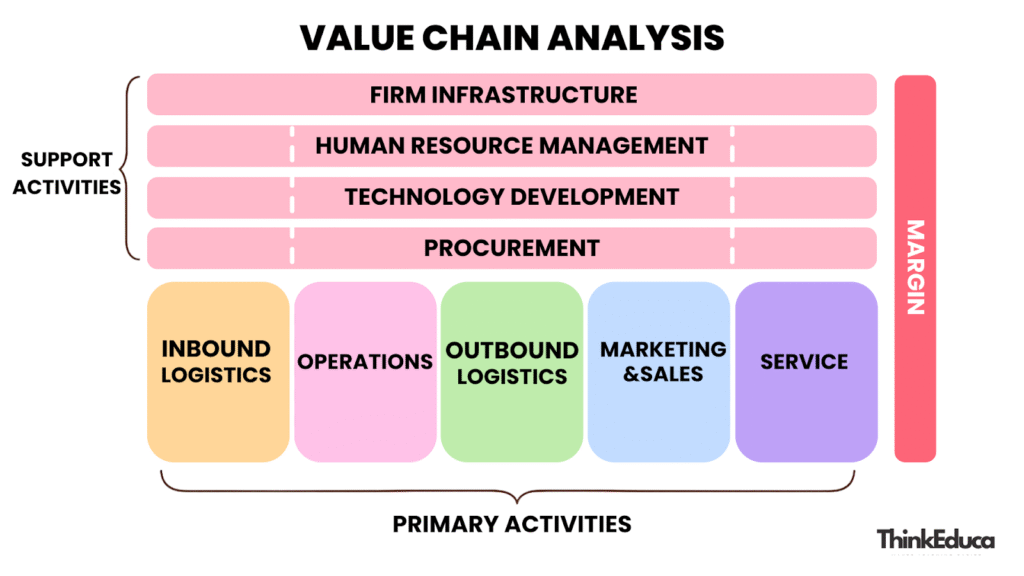
According to Porter’s Value Chain Model, Primary activities are the ones above—essential steps moving the product from creation to consumption or concept to customer:
1. Inbound Logistics – managing raw materials, suppliers, and inventory.
For Example: Amazon’s highly automated warehouses and robotics systems ensure that products are received, sorted, and stored efficiently — saving time and cost.
2. Operations – converting inputs into final products.
For Example: Toyota’s Lean Manufacturing system is a textbook case of operational efficiency. They minimize waste, optimize flow, and continuously improve — turning operations into a competitive advantage.
3. Outbound Logistics – warehousing and distributing the final products to customers.
For Example:Coca-Cola has one of the most advanced bottling and distribution networks in the world. That’s how it ensures every bottle reaches even the smallest stores globally.
4. Marketing and Sales – Promoting and selling the product — creating demand and customer interest.
Here’s where different types of marketing come in:
- Digital Marketing – Using SEO, social media, and email to build awareness.
- Traditional Marketing – TV, print, radio.
- Content Marketing – Educating and inspiring through valuable content.
- Influencer Marketing – Using trust and reach of personalities to connect with audiences.
- Performance Marketing – Paid campaigns optimized for measurable results.
For Example: Nike’s “Just Do It” campaign didn’t just sell shoes — it sold motivation.
Marketing turned an athletic product into a global movement.
5. Service – after-sales support, repairs, and customer assistance.
For Example: Think of Dell — their customer service and online support add massive value by keeping users happy and loyal.
Support activities Enable and enhance the efficiency of primary activities in short these aren’t customer-facing, but they’re the backbone of every business—they include,
1. Firm Infrastructure – management, planning, finance, and company structure.
For Example: Walmart’s data-driven infrastructure helps it manage global operations and track every product in real-time.
2. Human Resource Management – recruiting, training, and rewarding employees.
For Example: Google invests heavily in HR to keep innovation alive— from talent recruitment to employee wellness — because they know innovation comes from people.
3. Technology Development – R&D, process automation, IT systems.
For Example: Tesla continuously innovates in battery tech and software updates — adding value long after you buy the car.
4. Procurement – acquiring raw materials and negotiating supplier contracts.
For Example: IKEA works closely with its suppliers to keep costs low while maintaining high design quality — a perfect example of value through procurement.
When all these activities connect efficiently, they don’t just create value — they multiply it.
Margin is the “leftover”—the positive gap between what the customer pays and your total cost.
Margin = Total Value Created – Total Cost of Performing the Activities.
Every activity in the chain, whether primary or support, should push that margin HIGHER—by increasing the customer’s perceived value or by lowering costs.
That’s why the Value Chain isn’t just about making products…It’s about designing profitable systems that deliver value better than competitors.
2.1. How Value Chain Analysis Works (Step-by-Step B2U approach):
Step1:Identify all activities — list both primary and support activities.
Step2:Analyze cost and value — find where value is added and where costs are high.
Step3:Look for linkages — understand how activities influence each other (Example: Better training (HR) → higher productivity (Operations) → faster delivery (Logistics)).
Step4:Find competitive advantage — either by reducing cost or increasing differentiation. This simple reflection can help you redesign your operations to become more efficient and customer-focused.
2.2. Porter said that the Value Chain helps a company gain competitive advantage in two main ways:
1st.Cost Advantage: Streamline processes to perform activities more efficiently than competitors.
For Example: Walmart’s entire value chain — from supplier deals to distribution — is built to cut costs. Its advanced logistics and real-time inventory management let it sell at lower prices while still earning profit.
2nd.Differentiation Advantage: Offering something unique that customers value — even if it costs more.
For Example: Starbucks creates value through customer experience and brand atmosphere, not just coffee.
In short —Cost advantage makes you cheaper. Differentiation advantage makes you special.
3. How Internal Linking (Optimization and Coordination) Creates Power:
Here’s something many businesses overlook —Without optimization and smart coordination, even the biggest company can get stuck. Value chain analysis highlights the points of friction—mismatched supply, duplicated effort, or poor communication between teams. By systematically reviewing each link and their dependencies, companies can spot opportunities to automate, innovate, and reduce costs while improving customer outcomes.
For example, TBI, a tech distributor, unified its support and primary activities with a new platform, making it easier for sales and support to work together. This internal linking improved workflow visibility and boosted repeat business thanks to better partner satisfaction and seamless operations.
4. Common Mistakes to Avoid:
Many companies fail to get the full benefit of Value Chain Analysis because they:
- Treat it like a cost-cutting tool instead of a value-creation strategy.
- Ignoring customer perspective.
- Failing to align departments — breaking internal links.
Remember — a chain is only as strong as its weakest link. Strengthen every link, and you strengthen your entire business.
Conclusion:
So the next time you think about what makes a company successful — don’t just look at their products or profits. Look at their Value Chain. Because in business, value isn’t created in one place — it’s created across every step, every process, and every person who touches the product before it reaches the customer. That’s the power of Value Chain Analysis. For a more in-depth exploration of this topic, please visit ThinkEduca.com, where you will find detailed guides and resources.